

Pool plaster colours: how your finish changes the colour of the water
The plaster you choose sets the colour of the water. White plaster gives bright aqua, blues give clearer blue water, and greys and charcoals give a deep lagoon look.
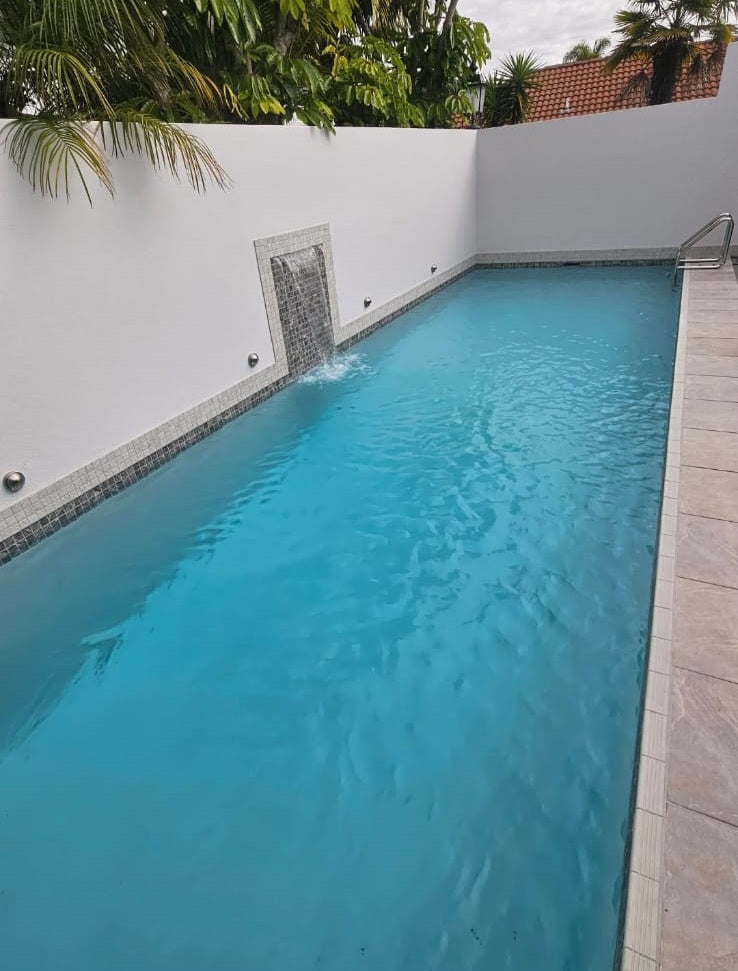
Water itself is nearly clear, so what you see is mostly the plaster underneath it, plus the sky and surroundings reflecting off the top. Choosing a plaster colour is really choosing the colour of your pool water.
The general rule
- White and pale finishes give bright, light aqua water that looks clean and tropical.
- Blue finishes give clearer, more saturated blues. The deeper the blue, the deeper the water colour.
- Green finishes give a natural, lagoon-style water that blends with planting.
- Grey and charcoal finishes give deep blue-green to dark, reflective water with a dramatic, mirror-like look.
The 12 Ultra Quartz™ colours
Ultra Quartz™ is a reflective quartz plaster made in New Zealand for local conditions. These are the 12 standard colours, from lightest to deepest water tone. The water colours are typical. Your pool will vary, as explained below.
| Colour | Plaster | Typical water colour | |
|---|---|---|---|
 |
Tropical White | Bright white | Brightest, lightest aqua |
 |
Aquamarine | White with aqua and teal flecks | Light, fresh turquoise |
 |
Coastal Sky | Pale white-grey with blue flecks | Light, clear blue |
 |
Pastel | Soft pale blue | Soft, light blue |
 |
Capri | Light to mid blue | Bright mid blue |
 |
Ocean | Aqua-turquoise | Vivid tropical turquoise |
 |
Bahama Blue | Sky blue | Saturated Caribbean blue |
 |
Denim | Deep blue | Deep, rich blue |
 |
Bali | Natural green | Green lagoon, resort style |
 |
Nardo | Light grey with dark flecks | Soft blue-green |
 |
Volcanic Grey | Mid grey with dark flecks | Deep blue-grey |
 |
Carbon | Charcoal | Darkest, deep lagoon and reflective |
Custom blends are also available for architecturally specified projects.
What else changes the colour?


- Depth: deeper water always reads darker and bluer than the shallow end or steps.
- Sky and sun: the same pool looks brighter on a clear summer day than under cloud.
- Surroundings: trees, planting, fences and the coping colour all reflect in the water.
- Lighting: pool lights change the colour at night. Warm white and cool white lights give quite different looks.
- Water balance: poorly balanced water can cloud, stain or etch the surface and change how it looks over time. See our 30-day start-up guide.
Light or dark: the trade-offs
Lighter colours
- Bright, inviting water, and you can see the bottom clearly.
- Dirt, leaves and stains are easier to spot, so the pool may need cleaning more often.
Darker colours
- A dramatic, natural look that suits modern architecture and landscaped gardens.
- Darker surfaces can absorb a little more heat from the sun.
- Natural variation and mottling are more visible on darker finishes, which is part of their character.
Natural variation is normal
All quartz and marble plasters are hand-applied, cement-based finishes. Some variation in colour, shade and mottling is normal and part of the look, and it is not a defect. Colour can also settle over the first weeks as the plaster cures.
Screens show colour differently, so always choose from a physical sample. Wet the sample and view it outside in daylight to get closest to the finished look. Order free samples.