

Common pool plaster problems and how to avoid them
Most problems with quartz and marble plaster come down to water chemistry, especially in the first 28 days. Here is what each problem looks like, what causes it, and how to prevent it.
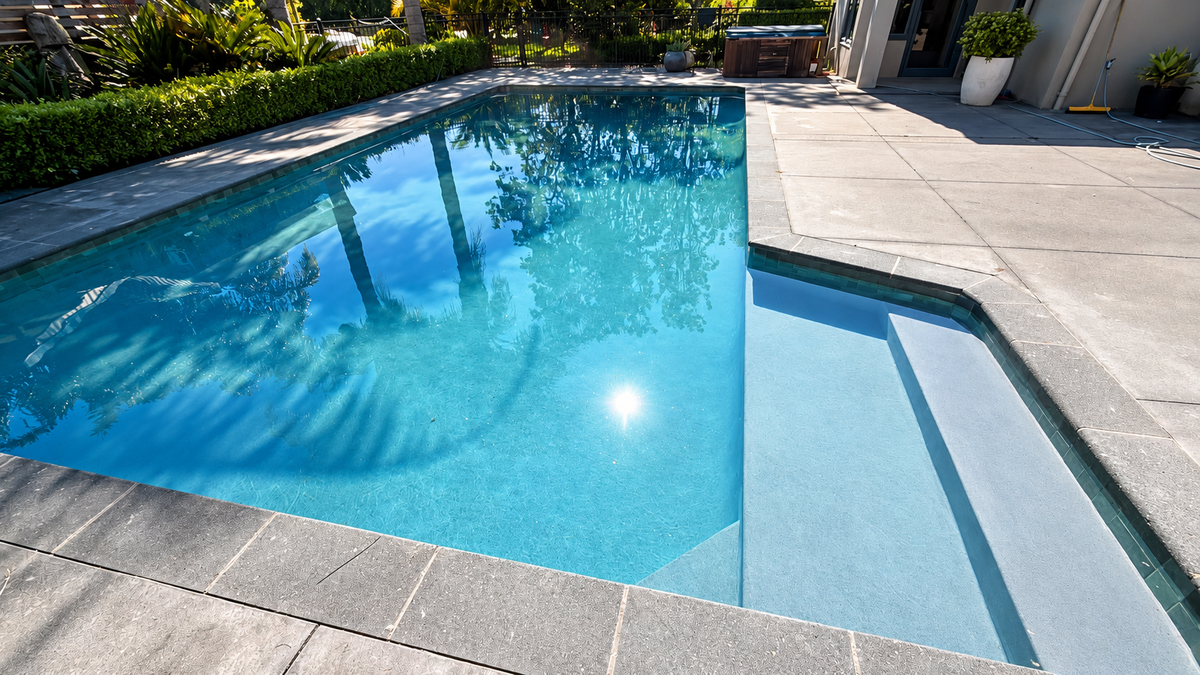
Quartz and marble plasters such as Ultra Quartz™ and Hydrazzo are cement-based finishes. They're tough and long-lasting, but they react with the water they sit in. Water that is out of balance will either attack the surface or leave deposits on it. Almost every common plaster problem traces back to that.
Balance is everything: the LSI
The Langelier Saturation Index (LSI) combines pH, alkalinity, calcium hardness, temperature and dissolved solids into one number.
- Below 0 (aggressive water): the water dissolves the plaster, causing etching, roughness and discolouration.
- Above 0 (scaling water): minerals come out of the water and deposit on the surface as scale.
- Target: keep the LSI between 0.0 and +0.3.
Our 30-day start-up guide explains how to calculate it, with the full factor table.
The common problems
| Problem | What it looks like | Usual cause | Prevention |
|---|---|---|---|
| Scaling | White or grey crusty deposits, often at the waterline, steps and returns | High pH, alkalinity or calcium (positive LSI), especially as water warms | Keep the LSI at 0.0 to +0.3. Test more often in summer. |
| Etching | A rough, sandpaper feel, dull patches and exposed aggregate | Aggressive water (negative LSI), low calcium, or acid added carelessly | Keep calcium hardness 200 to 400 ppm. Always pre-dilute acid and add it slowly in front of a return. |
| Spot etching | Small white spots or pitting | Often during curing, from poor water balance or undissolved chemicals sitting on the surface | Follow the start-up procedure. Never let undissolved chemicals sit on the floor. |
| Metal staining | Brown, green, blue or black stains | Metals such as iron, copper or manganese from fill water, bore water, corroded equipment or some algaecides | Test fill water for metals. Use a sequestering agent. Choose copper-free products. |
| Organic staining | Brown or green stains under leaves, berries or debris | Tannins from leaves left sitting on the floor | Keep the pool clean and the chlorine level steady. |
| Mottling and shading | Lighter and darker patches across the surface | Normal variation in a hand-applied cement finish, made worse by poor start-up water balance | Some variation is a natural feature. Careful start-up keeps it even. |
| Checking (craze cracks) | Fine surface cracks like a spider web | Shrinkage of the surface layer, often from rapid drying during application | Good application practice. Minor checking is cosmetic. |
| Delamination and hollow spots | Areas that sound hollow or lift away | Poor bond to the old surface when resurfacing | Proper surface preparation and a bonding coat such as Ultra Bond™. |


Five habits that prevent most problems
- Follow the start-up procedure exactly. Most damage happens in the first 28 days, while the plaster cures.
- Test regularly. Test pH and alkalinity at least weekly, and calcium hardness and stabiliser monthly.
- Keep the LSI between 0.0 and +0.3 all year round.
- Watch your stabiliser. Cyanuric acid at 100 ppm or above can permanently damage the surface. Dilute by partly draining and refilling.
- Always add chemicals to water, pre-diluted, and never let them sit undissolved on the plaster.
What to do if you notice a problem
- Test the water straight away and write down the results.
- Don't add strong chemicals or acid-wash the surface without advice. The wrong treatment can make staining or etching worse.
- Take photos and call us on 0800 446 378. We can help identify the cause and the right fix.