

Pool coping edges explained: bullnose, square edge or drop face?
The edge you choose shapes how your pool looks, how it feels to sit on and how well it keeps splash off the surround. Here is how bullnose, square edge and drop face coping compare.
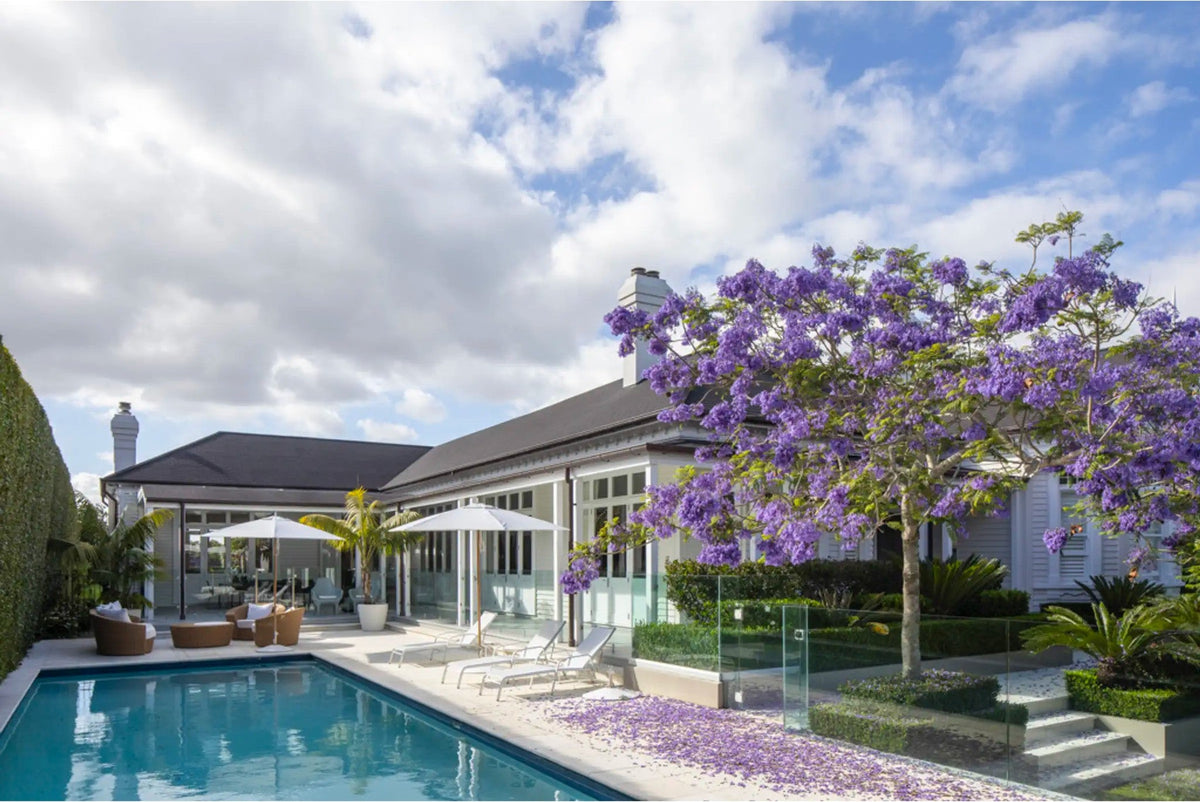
Coping is the cap that runs around the top of the pool wall. It finishes the edge, protects the top of the shell, and is where people sit, stand and climb out. The edge profile is the biggest design choice you'll make, so here's how the three main options compare.
The three edge profiles
Bullnose
A bullnose edge is fully rounded across the front. On our 40mm natural stone coping, that means a full 20mm radius. It's soft to sit on, kind on hands and knees, and gives a classic, traditional look that suits sandstone and granite.
- Best for: family pools, traditional and coastal homes, anyone who wants maximum comfort.
- Look: soft and classic.


Square edge
A square edge gives a crisp, straight line that suits modern architecture. Our natural stone square edge coping has lightly arrised (eased) edges, so it isn't sharp to the touch.
- Best for: contemporary pools, clean lines, matching square-edged pavers.
- Look: sharp and minimal.


Rebated drop face
Drop face coping has a thicker front edge that steps down to a thinner body. Our CMP porcelain coping is 40mm at the front and 20mm through the body, and our sandstone drop face is 38mm stepping to 20mm. The thick front gives a solid, substantial look at the waterline, while the 20mm body sits flush with 20mm pavers so the coping and surround meet level.
- Best for: pools surrounded by 20mm porcelain or stone pavers, where a seamless finish matters.
- Look: the weight of a thick slab, with a flush, modern surround.


The go-to coping for fibreglass pools
Fibreglass pool shells are moulded with a rounded, curved lip along the top edge. Left exposed, or capped with a flat coping, that curve can show between the coping and the water and make the edge look unfinished.
Our rebated CMP porcelain coping solves this. The 40mm drop face sits over the edge of the shell and hangs down past the curved lip, so the curve is hidden behind a crisp, square front edge. From the pool, you see a solid, straight line of coping instead of the shell's rounded edge.
- Hides the curved shell edge behind a clean 40mm front face.
- A crisp, modern waterline that makes a fibreglass pool look like a custom concrete pool.
- Flush with the surround: the 20mm body sits level with 20mm porcelain pavers, so the coping and paving meet without a step.
- Matching colours: every coping colour has pavers to match.
That's why it's the coping many pool builders choose for fibreglass shells. Talk to us about the right width and colour for your pool.
Why our porcelain coping uses a 3-piece mitred drop face
Many drop face copings are made by gluing a single strip to the front of a tile. Ours is different. The front of each piece is built from three mitred, waterjet-cut pieces, a design originally developed by Clive Pegden of SSL Distributors and now used on pools around the world.
- Strength and durability: three points of epoxy adhesion instead of one, so it is far less likely to fail than a single bonded face, which can come away over time.
- Precision: every mitre is waterjet cut for tight, clean joints. The front edge has a slight bevel, so it's comfortable to sit on and easy on the hands when getting in and out.
- A traditional 40mm overhang: helps stop water splashing up and over onto the surround.
Choosing a width

| Width | Suits |
|---|---|
| 300mm | A slim, modern edge and smaller pools. |
| 400mm | More presence and a comfortable place to sit. |
| 600mm | A wide, bold edge that doubles as seating and a step-out area. |
Comfort and safety
- All CMP porcelain coping carries a minimum R11 slip rating for wet outdoor areas.
- Textured natural stone finishes, such as flamed or sandblasted granite, add grip around the water.
- Lighter colours stay cooler underfoot on hot days.
How many pieces do I need?
Measure the pool's perimeter in metres, divide by the piece length (usually 0.6m) and add 5% for cuts. For an 8 x 4m pool: 24m ÷ 0.6 = 40 pieces, plus 5% = 42 pieces. The calculator on each coping product page works this out for you.
Every coping product page includes a dimensioned drawing of the profile, so you and your builder can check heights and overhangs before you order.